Infrastructure analysis. The largest infrastructure project in Uruguay’s history is neither a dam nor a motorway: it is a 273-kilometre railway line connecting Montevideo with Paso de los Toros. The Ferrocarril Central, inaugurated in April 2024, mobilised an investment above one billion dollars and, beyond its tracks, works as a case study in how Uruguay structures major public-private partnership (PPP) projects. For the foreign investor asking «how are large projects actually delivered here», this scheme is the most complete answer on offer.
The interest lies not only in the scale but in the model. An international consortium financed, designed, built and now operates the infrastructure under a long-term contract with the State. That structure — and the supplier ecosystem it pulled in with it — says more about Uruguay’s business climate than any promotional brochure.
What the Ferrocarril Central is
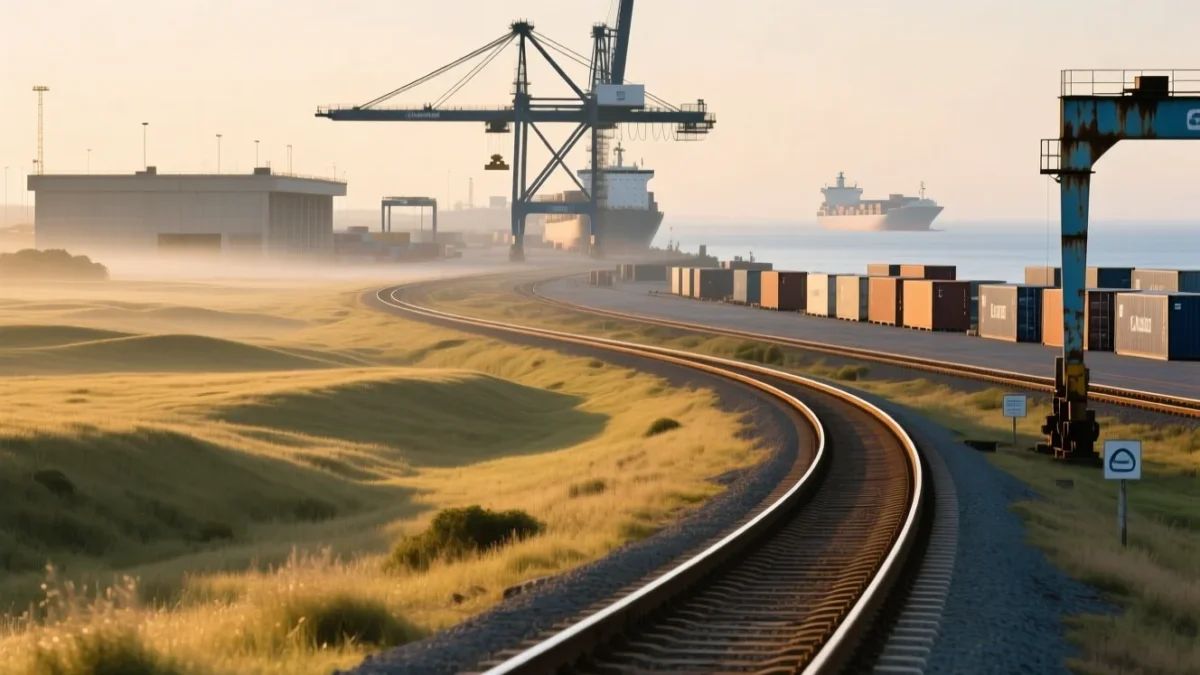
The project links the port of Montevideo with Paso de los Toros, in the country’s interior, over roughly 273 kilometres of track rebuilt for heavy freight. Its origin is concrete: to give a logistics outlet to the second pulp mill of Finland’s UPM, at Pueblo Centenario — one of the largest inflows of foreign direct investment Uruguay has received in its recent history. The new line halves transport times and multiplies freight capacity between the productive interior and the capital’s port.
But reducing the Ferrocarril Central to «the UPM train» would misread it. The works reconfigure the logistics of the country’s entire central corridor and lay the physical groundwork for other cargo — forestry, agri-industry, containers — to find a competitive alternative to road transport.
The PPP model: who finances, builds and operates
The contract was awarded under the public-private partnership regime to the Grupo Vía Central consortium, responsible for financing, designing, building, operating and maintaining the infrastructure for fifteen years. The consortium’s composition blends international experience with local capacity:
| Member | Origin | Role in the consortium |
|---|---|---|
| Sacyr | Spain | Consortium leader, majority partner |
| NGE | France | Railway engineering and construction |
| Saceem | Uruguay | Construction, local partner |
| Berkes | Uruguay | Engineering and assembly, local partner |
The participation of two substantial Uruguayan firms — Saceem and Berkes — alongside the Spanish and French groups is no minor detail. It reflects a local market with the technical capacity to partner as an equal on internationally scaled works, something not every country in the region can offer a foreign investor.
The multiplier effect: hundreds of suppliers in the interior
The economic impact of a project this size is not measured only in kilometres of track. During construction, it mobilised hundreds of small and medium subcontractors across the interior departments — earthworks, concrete, signalling, catering, transport — and created skilled jobs outside the capital. That territorial multiplier effect is precisely what a government seeks when structuring a PPP: that investment does not concentrate in Montevideo but irrigates the regions that historically sit at the margins.
For a services company weighing entry into the Uruguayan market, the lesson is operational: large projects open local supply chains for years, and the supplier that positions early in that ecosystem captures contracts that extend well beyond the initial works.
The new port terminal and what comes next
The Ferrocarril Central does not end at the track. Its counterpart on the coast is the new deep-water port terminal in Montevideo, designed to process pulp cargo and expand the capital port’s capacity. Railway and terminal form an integrated logistics system: without the port, the train unloads into a bottleneck; without the train, the terminal receives trucks instead of convoys.
The Uruguayan State has flagged railway development as a forward infrastructure priority, opening the door to new sections and to reactivating corridors that are underused today. For private capital, this defines a pipeline: where a first rail PPP succeeded, it is reasonable to expect the next ones to follow.
Key takeaways
The Ferrocarril Central is more than Uruguay’s largest-ever infrastructure investment: it is the practical demonstration of how the country structures internationally scaled projects. A consortium combining Sacyr and NGE with Uruguay’s Saceem and Berkes, a fifteen-year PPP contract, a multiplier effect reaching hundreds of interior suppliers, and a port terminal that completes the logistics system — together they give the foreign investor an unusually granular basis on which to judge a jurisdiction’s seriousness. The line has operated since 2024, and the policy signal points to more of the same. For anyone assessing Uruguay as a logistics base, the map this project redraws matters as much as the rails that compose it.
Primary sources
- MTOP (Ministry of Transport) — Ferrocarril Central project (273 km, PPP)
- MTOP — Description of the railway infrastructure
This article is for general information only and does not constitute legal, tax or financial advice. Symbol Consulting is not a licensed advisor in Uruguay; investors should engage a qualified local professional before making decisions. Data reviewed as of 9 July 2026.