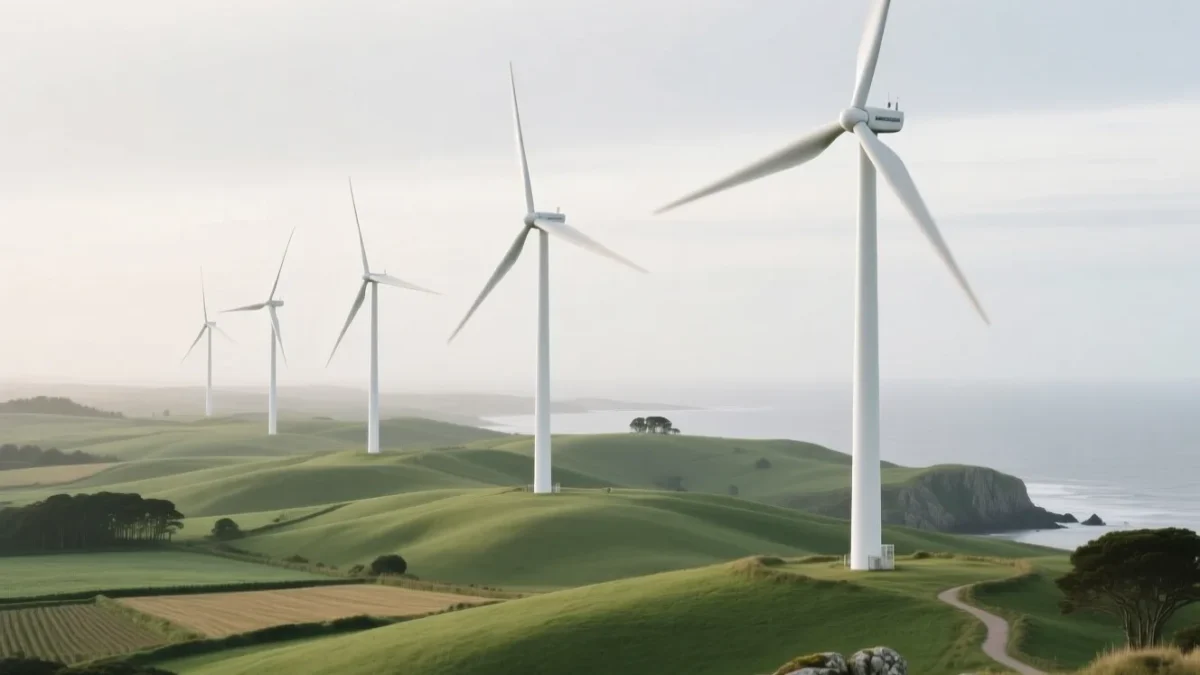
Sector opportunity. Uruguay solved its electricity transition before almost any other country in the region: its grid already runs on mostly renewable power. The question occupying the country in 2026 is what to do with the surplus, and the answer is green hydrogen. The official roadmap sketches an industry aiming to produce one million tonnes a year by 2040 and to mobilise on the order of USD 18 billion in investment. For a service company, the relevant signal is not in those long-horizon figures, but in what is already happening on the ground.
This article reviews the sector’s targets, the pilot project that opened the path and — the point that matters most to a consultant — where the concrete niches appear for suppliers, engineering, logistics and specialised services.
The 2040 roadmap: the figures that set the ambition
The national green-hydrogen strategy sets explicit targets worth keeping in view before assessing any opportunity:
| Indicator | Target by 2040 |
|---|---|
| Green-hydrogen production | ~1 million tonnes per year |
| Additional renewable capacity | ~18 GW |
| Electrolysis capacity | ~9 GW |
| Estimated investment | ~USD 18 billion |
| Potential export revenue | around USD 2.0 billion per year |
| Estimated direct jobs | more than 30,000 |
The logic behind these targets is simple: Uruguay has wind and sun to spare, a stable grid and renewable-generation capacity that exceeds domestic demand. Green hydrogen — and its derivatives such as methanol or ammonia — is the route to monetise that surplus by turning it into an exportable good. The state operator UTE and the innovation agencies structure the framework; private capital provides the scale.
Khairos: the pilot that put the first electrolyser to work
The long-term ambition needed a tangible proof, and that proof is Khairos (Kahirós), in Fray Bentos: the country’s first green-hydrogen project and the first in Uruguay’s clean-energy sector to reach financial close. It is developed by a consortium of Uruguayan companies — Ventus (renewable energy), Fraylog (logistics) and Fidocar (sustainable mobility); its lead investor is Grupo Santander, with a USD 20 million green loan from the IFC — the World Bank Group’s first global green-hydrogen investment — and USD 1 million from the UN REIF fund; its client is Montes del Plata, which will use the hydrogen in heavy-duty trucks. With a total investment of roughly USD 38.7 million, the pilot combines a 2 MW electrolyser fed by a 4.8 MW solar farm.
What matters is not only the technology but the end use. The hydrogen produced fuels a fleet of fuel-cell trucks assigned to timber transport — forestry logistics being a pillar of the Uruguayan economy — with an estimated output on the order of 77 tonnes of hydrogen a year and emissions savings near 870 tonnes of CO₂ per year. Khairos is not a laboratory experiment: it is a commercial use case in a real sector, and that makes it the country’s strongest calling card for industry investors.
Beyond Khairos: the project pipeline
The Fray Bentos pilot opens a wider portfolio. Other projects — such as initiatives grouped under hydrogen-derivative schemes for heavy transport and export — are advancing with a mix of private investment and public grants. To this is added a frontier that is still early but high in potential: offshore wind. Uruguay has identified coastal blocks with generation capacity of up to 3 GW, a scale that, if realised, would entirely transform the supply equation for large-scale hydrogen production.
The pattern is clear: the country is not betting on a single mega-project but on a sequence of initiatives combining foreign capital, development banking and local capacity. That design reduces the risk of an isolated failure and, for the service provider, multiplies the points of entry.
Where the opportunities lie for service companies
Here is the practical interest for capital that does not come to build electrolysers but to serve those who do. A nascent industry of this scale generates demand in chains that rarely make headlines:
- Engineering and technical consulting: feasibility studies, environmental permits, plant design, integration of renewables with electrolysis.
- Specialised logistics: transport and storage of hydrogen and derivatives, refuelling infrastructure, cold chain for ammonia and methanol.
- Local content: public policy favours the participation of national suppliers, opening space for joint ventures between foreign firms and Uruguayan partners.
- Corporate services: structuring investments under the free-zone and COMAP regimes, regulatory compliance, specialised human capital.
Timing matters: in a starting industry, the supplier that positions during the pilot and early-project phase captures relationships that consolidate as the sector scales toward its 2040 targets.
Key takeaways
Uruguay’s green hydrogen combines what rarely coincides: a roadmap with concrete figures — one million tonnes and ~USD 18 billion by 2040 — a pilot already operating with a real commercial use case in Khairos, and a diversified pipeline that includes the offshore-wind frontier. For the industrial investor, the country offers the energy feedstock that hydrogen production demands. For the service company, the value lies in the chains the industry opens: engineering, logistics, local content and corporate structuring. The bet is long-term and not free of execution risk, but the fact that the first electrolyser already produces hydrogen for real trucks turns the promise into something verifiable. In 2026, Uruguay stopped talking about green hydrogen in the future tense.
Primary sources
- Uruguay Presidency — Green Hydrogen Roadmap: USD 18bn investment to 2040
- MIEM — Green-hydrogen and derivatives projects (HIF, Tambores, Kahirós)
- IFC (World Bank Group) — Investment in the Kahirós project (USD 20M green loan)
- World Bank — Fact sheet on the first green-hydrogen project (Grupo Santander, USD 38.7M)
This article is for general information only and does not constitute legal, tax or financial advice. Symbol Consulting is not a licensed advisor in Uruguay; investors should engage a qualified local professional before making decisions. Targets and figures correspond to the official green-hydrogen roadmap and were reviewed as of 14 July 2026.